Case study · Enterprise
M-Five Security
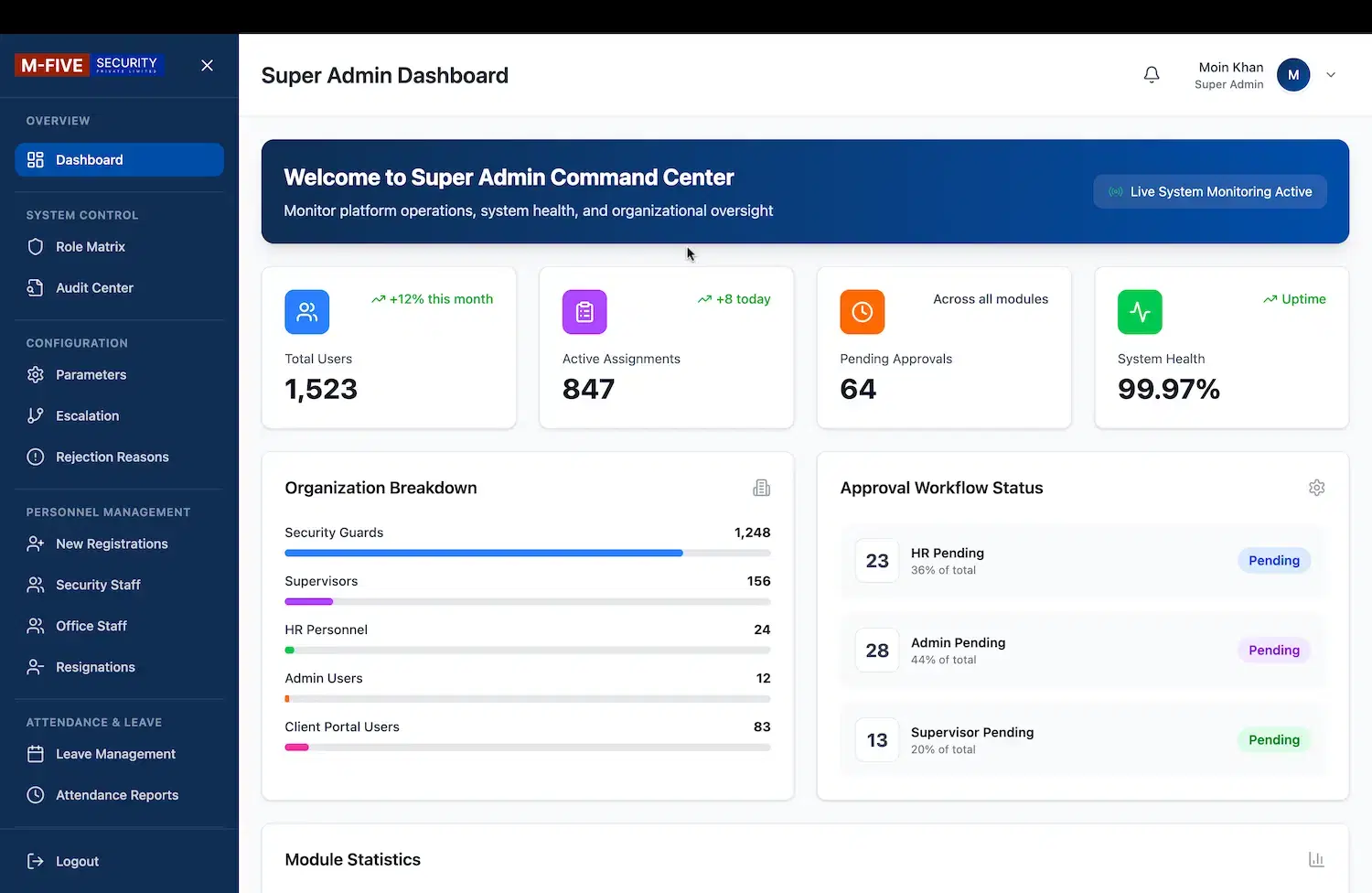
Enterprise security workforce management. An operations platform for a security services company — guards, supervisors, clients, sites, attendance, and workforce administration in one system.
- My role
- Full-stack architecture, RBAC, notifications, and production delivery
- Built at
- Uniworld Studios Pvt. Ltd.
- Links
- Private product — no public link
01The problem
Security operations involve many roles with very different responsibilities. Onboarding needs identity verification, sensitive documents must be stored safely, and approvals and notifications have to move reliably between HR, admins, supervisors, and guards.
An enterprise-grade MERN application for managing security operations end to end — guards, supervisors, clients, sites, attendance, and workforce administration — built on modular REST APIs and AWS-backed infrastructure.
02My contribution
- Architected modular REST APIs designed for future feature expansion
- Designed the RBAC model with fine-grained permissions for six roles
- Built the BullMQ + Redis notification pipeline
- Integrated Aadhaar verification for employee onboarding
- Ran production infrastructure on AWS with automated deployments
03Architecture
- 01ClientReact.js role-based dashboards
- 02APINode.js / Express modular REST APIs, JWT middleware and protected routes
- 03DataMongoDB with tuned queries and indexes
- 04Async jobsBullMQ queues backed by Redis for notifications
- 05StorageAWS S3 for employee documents and verification files
- 06DeliveryAWS EC2 behind an NGINX reverse proxy, GitHub Actions CI/CD
04Challenges & approach
- Fine-grained permissions across Super Admin, Admin, HR, Client, Supervisor, and Security Guard roles
- Delivering asynchronous notifications reliably without blocking API requests
- Verifying identity and handling sensitive documents during onboarding
Permissions are enforced in API middleware rather than only in the UI, so every route checks the caller's role. Notification work is pushed onto BullMQ queues backed by Redis and processed asynchronously. Aadhaar verification runs through Cashfree Secure ID, and employee documents are stored on AWS S3. The services run on AWS EC2 behind NGINX, with GitHub Actions handling deployments.
05What was built
- Guard, supervisor, client, and site management
- Attendance and workforce administration
- Registration and multi-level approval workflows
- Six-role access control
- Aadhaar verification during onboarding
- Event-driven notifications
06Outcomes
- Production-grade authentication with protected routes and middleware
- Optimised MongoDB queries and indexing for faster API responses
- Automated CI/CD for repeatable AWS deployments
As reported in my resume for this engagement.
Building something similar?
I can walk you through this architecture or help you build your own version.